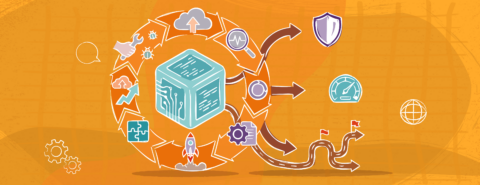




What is software maintenance and what benefits does it bring?
Implementing an IT system doesn’t mark the end of the work on the software. That’s the point at which the application starts operating in a real-world environment: it serves users, processes data, connects with other tools, and needs to keep pace with changes in the business.
That’s exactly why software maintenance is needed. This refers to the activities that help keep a system stable, secure and useful after it’s gone live. It covers not just bug fixes, but also updates, monitoring, performance optimisation, feature development, and adapting the system to new business needs.
Well-maintained software supports a company for years. Neglected software, over time, starts to slow down teams, drive up costs, and hinder further growth.
Key takeaways: – Software maintenance covers activities carried out after a system goes live, such as monitoring, updates, bug fixing and feature development. – Regular maintenance helps keep an application stable, secure and performant. – A lack of system maintenance leads to growing technical debt, greater risk of downtime, and higher development costs. – Well-run software maintenance extends an application’s lifecycle and reduces the need for costly modernisation. – Univio helps companies maintain, modernise and develop their software, helping to ensure system stability, security, performance, and alignment with changing business needs.
What is software maintenance?
Software maintenance is a set of activities that keep an IT system in good shape after it’s been deployed. Its aim is to ensure the application runs in a stable, secure and efficient way within a changing technological and business environment.
In practice, this doesn’t mean a one-off fix, but ongoing care for the system: monitoring how it’s performing, fixing faults, updating components, improving security, optimising performance, and developing features in line with the company’s needs.
What does software maintenance actually involve?
Software maintenance means regularly checking, correcting and developing a system so it can keep supporting business processes effectively.
The scope of maintenance depends primarily on the role the system plays within the organisation. Maintaining a simple internal application looks very different from maintaining an e-commerce platform, a B2B portal, a PIM or CRM system, or dedicated systems supporting specific business processes.
Software maintenance most often covers areas such as:
System monitoring and rapid response to errors Monitoring lets you check system availability, performance, integrations and any emerging errors. This makes it possible to catch problems early, before they affect users, sales or teams’ work.
Fault fixing and application stabilisation Maintenance covers fixing technical bugs, issues in business logic, and malfunctioning forms, integrations, order processes or admin panels.
Technology and integration updates Regular updates to libraries, frameworks, databases, external APIs and integrations help maintain system compatibility and reduce the risks associated with outdated components.
Security improvements and access control Software maintenance includes security updates, permission reviews, access control, vulnerability analysis, and responding to new threats. This is especially important in systems that process customer data, orders, payments or product data.
System performance optimisation Maintenance helps improve the elements slowing an application down. This can include optimising code, database queries, infrastructure, cache or data synchronisation.
Feature development and business alignment Maintenance isn’t limited to fixing bugs. It can also involve adding new features, extending modules, implementing integrations, and preparing the system for a larger scale of operation.
What benefits does regular software maintenance bring?
Regular software maintenance delivers many benefits, from both a business and a technology perspective. The most important of these are:
- Easier system development – clean code, up-to-date documentation and a well-organised architecture shorten the team’s working time and allow new features to be rolled out faster.
- Lower risk of downtime – monitoring, testing, backups and disaster-recovery procedures help spot problems more quickly and limit their impact on the business.
- A higher level of security – regular updates, system reviews and access control reduce the risk of cyberattacks, security incidents and data loss.
- Better application performance – system optimisation helps maintain smooth operation even as the number of users, products, orders or integrations grows.
- Lower costs in the long run – regular maintenance helps limit technical debt and avoid costly modernisation projects or emergency repairs.
- A longer system lifecycle – well-maintained software can effectively support a business for many years without needing a complete replacement.
Which systems most often need software maintenance?
Software maintenance is particularly important for systems that have a direct impact on sales, customer service, data, logistics or the work of internal teams. The greater an application’s importance to the business, the greater the risk associated with a lack of regular maintenance.
The systems that most often require maintenance are:
- e-commerce platforms
- B2B portals
- PIM, CRM and ERP systems
- dedicated applications
- order and customer service systems
- integrations between systems
- internal applications supporting operational processes
Does maintenance only apply to dedicated systems?
No. Software maintenance applies to both custom-built systems and off-the-shelf solutions. What differs is the scope of work and the division of responsibility.
With custom-built software, a company has greater influence over the architecture, development, integrations and approach to system maintenance. That’s why it’s worth factoring in future maintenance and development at the project stage.
With solutions such as off-the-shelf software, part of the responsibility falls to the vendor. That said, you still need to keep control over configuration, integrations, data, user access, and how the system aligns with your business processes.
Software maintenance as an investment in stability and growth
Software maintenance is particularly important for systems handling sales, orders, payments, product data, logistics or internal processes. If such a system stops working, the problem quickly stops being purely an IT issue. It can affect customer service, order fulfilment, teams’ work and sales results.
In many companies, it’s difficult to handle this entirely in-house. The IT team has ongoing projects, new deployments and urgent tickets, so maintenance tasks often get pushed down the priority list. A technology partner such as Univio can take on some of that responsibility: monitoring the system, responding to errors, updating components, improving performance, and developing the application as business needs change.
Talk to a Univio expert and find out how to keep your software stable, secure and evolving.
Below, we’ve put together answers to the questions we’re asked most often about software maintenance.
FAQ
Why is software maintenance so important? Software maintenance helps keep a system stable, secure and efficient. Regular maintenance activities reduce the risk of downtime, limit technical debt and make it easier to keep developing an application.
How can you improve the software maintenance process? The process can be improved through up-to-date documentation, system monitoring, automated testing, regular updates, clear ticket prioritisation, and planned reduction of technical debt.
Is it worth working with a technology partner for software maintenance? Yes, particularly when the system is important to the business and the in-house team doesn’t have the time or the expertise to handle maintenance on its own. A technology partner can provide specialist knowledge, a fast response to problems, and support for the software’s ongoing development.
How much does software maintenance cost? The cost of maintaining a system depends on its complexity, the number of users, the scope of integrations, and the expected level of support. For business-critical systems, annual maintenance spend often amounts to somewhere between a few and around fifteen percent of the implementation cost.